Showing posts with label homemaking. Show all posts

Thursday, June 11, 2020

New Vintage Cookbook to Share: Your Share - How to Prepare Appetizing, Healthful Meals with Foods Available Today: Vintage Ephemera: Vintage Housewife


I absolutely love vintage cookbooks and the little advertising pamphlets or booklets from the mid century era.  These little gems were usually published and distributed by popular food or appliance companies.  They were distributed as marketing material to highlight a certain appliance, like a Frigidaire Refrigerator Or Kitchen-aid Mixer.  Sometimes, however, they were also distributed by banks, electric companies, and even an auto parts companies like the NAPA / Regal Ride cook book seen below (it is the blue one in the top left corner, I will feature it in an upcoming blog post so you can get a better look).
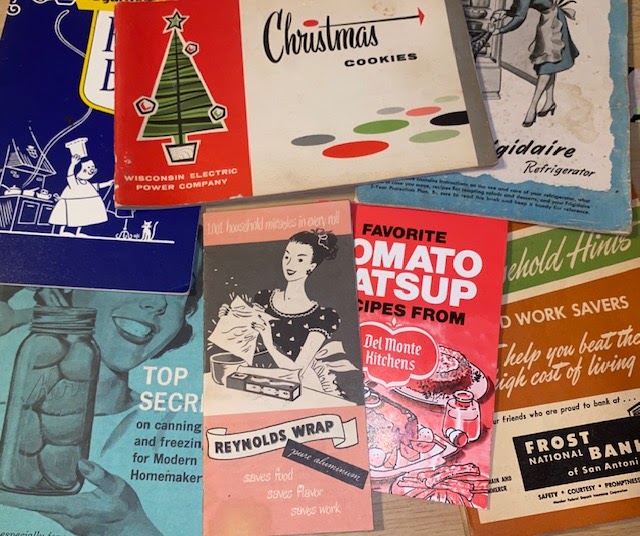
picture of pamphlets and booklets from my personal collection

These pamphlets were distributed a few different ways, I have found by talking to past generations of home makers while working in a senior living community.  Some were distributed in the super market, with a display of the product, much like we see coupons or recipes on hang pads.  Others were tucked in an electric bill or banking statement.  The booklets included with an appliance may come in the appliance box or handed out by a salesman while making his sales pitch. They, like the new appliances of the time,  were for the "modern homemaker" and usually had hints and recipes to make her life easier and more carefree.  

I am thrilled to have found this little gem, Your Share - How to prepare appetizing, healthful meals ** with foods available today*** a Betty Crocker Cookbook (lette?) .  It comes at the perfect time since prices of meat are climbing and limits have been put in place on certain household items and foods.

It was published in 1943 by General Mills, Inc.  It was to help with the rationing put in place during World War II.  We are not at war now, obviously, but I think we can appreciate the tips and helpful hints as much now as anytime.

I will share more of this booklet, with commentary, in the next few blog posts.  Be on the look out for tips and tricks on stretching your meat, multiplying your eggs, and making your cheese go further, for example, as I break it into sections.

Here are some more of these pamphlets from the mid century era.


xoxoTiffany


Monday, February 28, 2011

Monday means....Laundry Day TIps

Looking for brighter whites or bolder colors? The answer just might be white distilled vinegar. It’s a safe and inexpensive way to boost the power of your detergent and add a little more muscle to your stain remover. With vinegar in the mix, your clothes have never looked better.
Here are some more laundry tips using the power of vinegar.....
Prevent lint from clinging to clothes by adding 1/2 cup white distilled vinegar to the wash cycle.

To remove soap residue that makes black clothes look dull use white distilled vinegar in your final rinse.

Get stained white socks and dingy dishcloths white again. Add 1 cup white distilled vinegar to a large pot of water, bring it to a rolling boil and drop in the articles. Let soak overnight.

Some stains on clothing and linens can be soaked out using equal parts milk and white distilled vinegar.

Before washing a mustard stain, dab with white distilled vinegar.

Attack spaghetti, barbecue, or ketchup stains
with a white distilled vinegar and water solution.

Remove perspiration odor and stains on clothing, as well as those left by deodorants, by spraying full-strength white distilled vinegar on underarm and collar areas before tossing them into the washing machine.

Forgot that you left wet laundry in the machine and it now smells moldy? Pour a few cups of white distilled vinegar in the machine and wash the clothes in hot water. Then run a normal cycle with detergent.

Remove smoky odors from clothes by filling the bathtub with very hot water and 1 cup white distilled vinegar. Hang the garments above the steaming water and shut the door so the steam can penetrate the fibers.

Keep the steam iron clean and in good working order by getting rid of mineral deposits in steam vents and spray nozzles. Fill the water chamber with a solution of equal parts white distilled vinegar and distilled water. Set it in an upright position and let it steam for about 5 minutes. When the iron is cool, rinse the tank with water, refill and shake water through the vents onto an old cloth. Test before using.

Remove scorch marks from an iron by rubbing it with a warmed-up solution of equal parts white distilled vinegar and salt. If that doesn’t work, use a cloth dampened with full-strength white distilled vinegar.

Remove musky smells from cotton clothes by sprinkling them lightly with white distilled vinegar and then pressing them.

Get water and salt stains off shoes and boots by wiping them down with a solution of equal parts white distilled vinegar and water.

Give patent leather shoes and bags a better shine by wiping them down with white distilled vinegar.

Get cleaner laundry! Add about 1/4 cup white distilled vinegar to the last rinse. The acid in white distilled vinegar is too mild to harm fabrics, yet strong enough to dissolve the alkalies in soaps and detergents. Besides removing soap, white distilled vinegar prevents yellowing, acts as a fabric softener and static cling reducer, and attacks mold and mildew.

Eliminate manufacturing chemicals from new clothes by adding 1/2 cup white distilled vinegar to the water.

Remove soap scum and clean the hoses of your washing machine with white distilled vinegar. Periodically run the machine with only a cup of white distilled vinegar in it—nothing else added to the wash cycle.

Bring out bright colors by adding 1/2 cup white distilled vinegar to the rinse cycle.

Fluff up wool or acrylic sweaters (hand- or machine-washed) and rid them of soap smell with 1/2 cup white distilled vinegar in the last rinse water.

Get rid of the tiny holes left along the hemline when you take out the hem of any garment by moistening a cloth with white distilled vinegar, placing it under the fabric and ironing.

The above tips are from Vinegar Tips website.

Happy Homemaking

Tiffany

Monday, February 21, 2011

Laundry Day

 "Washing the laundry is what a woman does that nobody notices unless she hasn't done it"  Aunt Middle Mary  

I bought a new (new to me) book yesterday at Half Price Books and it is just full of homekeeping tips.  The book is Mrs. Dunwoody's Excellent Instructions for Homekeeping: Timeless Wisdom and Practical Advice
It is available by following the link to amazon
, as well.  I will be sharing some of these tips on future posts but today I want to share some for my Monday Laundry Tips post.  I hope you find these useful.

Today's tip will focus on starching.  I like to starch David's work shits, they just look crisper and nicer when wearing.

"Starching is an effort to replace the original finish which the textile manufacturer gave to the fabric, and which, in most cases, is removed when the garment is washed.  Miss Sallie Anne's recipe for starch gives clothes a beautiful finish, leaving the fabric smooth and pliable and giving it a certain 'feel' which makes it attractive.  there is nothing quiet like a the feeling of putting on a freshly laundered and starched garment that Miss Sallie Anne has tended to." page 59.

Miss Sallie Anne's Superior Recipe for Starch

2-6 tablespoons cornstarch
1/3 cup cold water
1 quart boiling water
1.2 teaspoon lard, paraffin, or any white wax

Mix the starch and part of the cold water, and stir into the boiling water in a double boiler.  Ise the remaining waterto rinse out the adhering starch.  Add the lard or white wax, and cook for 15 to 20 minutes.  Strain if lumps are found.  This paste can be thinned with hot water until it gives the stiffness desired to the fabric.
For white clothes, use the starch as hot as the hands can stand.  Hot starch penetrates better and more evenly, and does not leave glazed spots when ironed.  Keep the bulk of the starch hot and use only a part of it at a time, replacing it frequently when it becomes cold and thin.  More satisfactory results are obtained by having two pans od starch, besides the reserve supply.  Dilute one with enough ater to make a good paste for the thinner garments, and keep the starch in the other pan sufficiently thick for the heavier fabrics.
Starch first those garments which are to be the stiffest.  Garments wrung very dry before starching will be stiffer than wetter ones.

Happy Homemaking...

Tiffany
this post is linked to Penny Worthy Project